Read these short summaries of each session with thanks to:
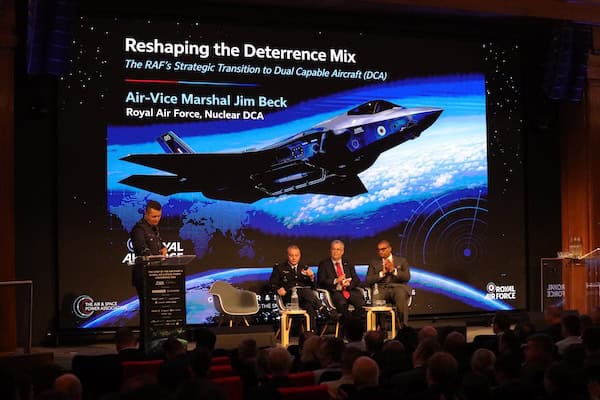
Session 1: Nuclear – Back to the Future?
In this session Air Vice-Marshal Jim Beck, RAF Director Capability & Programmes outlined the UK’s return to NATO’s dual-capable aircraft mission and the need to rebuild the RAF’s ‘nuclear IQ’. Lieutenant General Stéphane Virem, Commander, Strategic Air Forces, French Air & Space Force, emphasised that credible deterrence depends upon sovereign decision-making, continuous readiness and strategic culture. Dr Brendan Mulvaney, Director of the China Aerospace Studies Institute, argued that China’s nuclear expansion is reshaping conventional deterrence and alliance dynamics. Chauncey McIntosh, Vice President & General Manager, F-35 Programme at Lockheed Martin, reinforced that enduring deterrence depends upon trusted alliances as much as advanced technology. The overriding message: deterrence is ultimately measured not by what nations possess, but by what adversaries believe allies are prepared and able to do together. Trust, training and visible credibility and demonstrable will are what constitute meaningful deterrence.
Session 2: Operationalising the Space Domain
In this session, General Chance “Salty” Saltzman, Chief of Space Operations, led a compelling discussion on how we move from simply operating in space to truly operationalising the domain. Drawing on 35 years of service and four years building the US Space Force, he reflected on the importance of leadership, decision-making and having the courage to choose a path while building capability in a new domain. Joined by RAdm Tony Williams (UK Space Command), Maj Gen Greg Novak (Australian Space Command), Dr Julia Balm (Freeman Air & Space Institute) and Dr Mike O’Callaghan (Airbus), the panel highlighted the significant international progress being made in developing coherent space strategies. While many lessons can be drawn from maritime, land and air power, the unique realities of physics ensure that space remains a domain unlike any other. A key takeaway was Gen Saltzman’s assertion that “Space is the ultimate team sport.” Space power depends upon alliances, industry, academia and civil-military collaboration. Orbital mechanics ignore national borders and make information sharing, interoperability and collective understanding operational necessities rather than desirable ambitions. The discussion also reinforced that space is no longer a benign environment. As dependence on space-based capabilities grows, so too does the need for credible deterrence, resilient architectures and the development of Space Control capabilities. Preparedness remains the foundation of credible deterrence. The panel also emphasised the need to build both a space-minded force across the conventional domains and a professional cadre of space specialists capable of developing the doctrine, expertise and training needed for future operations.
Session 3: Putting the Integrated into IAMD
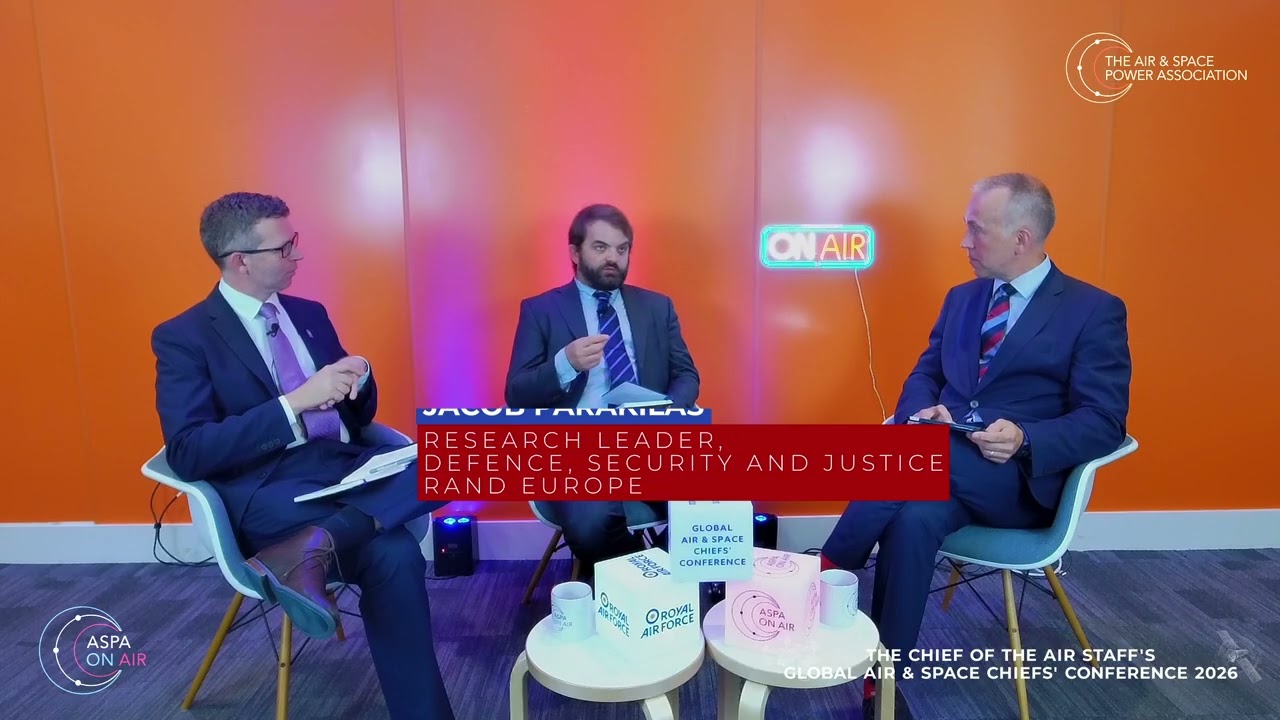
The central lesson from this session was clear: integrated attacks demand integrated defence, built on trusted relationships, common standards, resilient networks and sustained industrial capacity. The session addressed Integrated Air and Missile Defence with the panel clear that the decisive capability is not any individual sensor, platform or effector; it is the integration of the entire defensive enterprise. Air Vice-Marshal Andy Martin, RAF Director IAMD, emphasised resilient command and control, shared data and ‘any sensor, best effector’ decision-making across government, allies and domains. Lt Gen Jamie Speiser-Blanchet, Commander, Royal Canadian Air Force, argued that integration is itself the capability, particularly across Canada’s vast Arctic approaches and through NORAD, NATO and Five Eyes. James Black, Deputy Director for Defence and Security, RAND Europe, stressed that IAMD is a socio-technical system requiring political permissions, industrial endurance, informed sequencing and non-military levers as much as equipment. Domenico Vigilante, Leonardo Electronics Division Head of Technology and Innovation, described the transition from interoperable systems towards an adaptive ‘kill web’, capable of orchestrating sensors, decision nodes and effectors dynamically. The discussion was especially timely following the establishment of the ten-nation Integrated Anti-Ballistic Missile Coalition, intended to develop shared requirements, strengthen industrial cooperation and establish a roadmap towards European operational capability.
Session 4: The Integrated Force
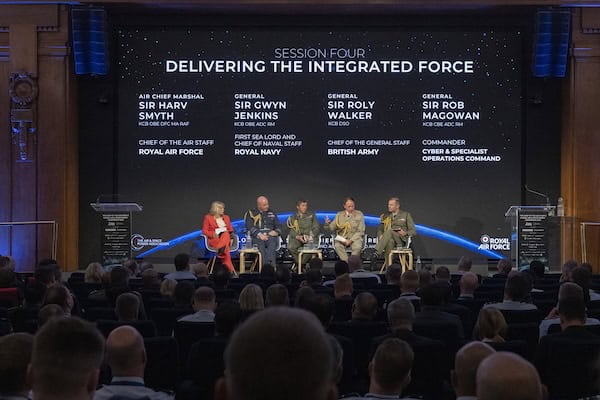
Four Chiefs, one panel. A powerful session closinmg Day One of the Global Air and Space Chiefs Conference saw Air Chief Marshal Sir Harv Smyth, Chief of the Air Staff, General Sir Gwyn Jenkins, First Sea Lord and Chief of Staff of the Royal Navy, General Sir Roly Walker, Chief of the General Staff, British Army, and General Sir Rob Magowan, Commander, Cyber & Specialist Operations Command, united on stage to discuss how the UK’s services will develop and deliver a fully integrated approach to operations. Though representing their respective services, the message from all was of One Defence. At a campaign level, warfighting does not occur in any domain alone. Not on land, at sea, in space, or from the air. As the breadth, depth, and scale of threats have increased in recent years, the Chiefs highlighted the need for ever-greater integration across Defence, ensuring the UK can respond effectively to increasingly complex challenges. Their shared view was clear: an integrated approach to modern warfare reduces risk, maximises operational effect, and sustains both mission success and the force over the long term. With collaboration, innovation and integration at the heart of the discussions, day one set the tone for a conference focused on meeting today’s threats while preparing for tomorrows.
Session 5: Contemporary Air & Space Power: Harder, Better, Faster, Stronger
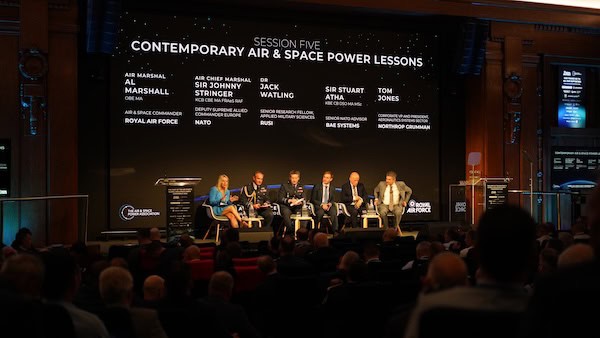
The final panel session of GASCC 2026 brought together a high-octane team to consider trending Air & Space Power lessons. Air Marshal Al Marshall (RAF Air & Space Commander) and Air Chief Marshal Sir Johnny Stringer (NATO DSACEUR) offered Commanders’ views; Dr Jack Watling (RUSI) injected lessons learnt from Russian experience; Sir Stu Atha (BAE) and Tom Jones (Northrop Grumman) wove industry’s thoughts into the discussion. In a deep, rich, and compelling discussion, some recurring themes leapt to the fore. Ukraine’s ongoing resistance to Russia’s illegal invasion remains a key theme for NATO: Ukraine’s today – defending home turf – could be wider Europe’s tomorrow. Ukraine’s struggle prompts PRAISE (partnership, resilience, adaptability, integration, sustainment (enough). Partnership, between armed forces and industry, bringing tacticians and technicians together across allied nations, is vitally important for both deterrence and coherent response. Credible deterrence rests on the resilience of the industrial base, something to be considered across all 32 allies (and wider). This industrial base ought to be designed to maximise adaptability, exploiting dual-use technologies and leveraging the latent capacity of typically civilian-oriented manufacturing potential to rapidly shift from ‘pilot light’ to ‘full flame’ munitions and materiel production. Successful nations should build on partnerships, trust, and collegiate conceptual thinking to ensure that standards, protocols and technologies are designed from the outset with integration in mind, underpinning operational coherence and further reinforcing industrial resilience (factory X in country A could take over as / when factory Y in country B became compromised). The confluence of partnership, resilience, adaptability, and integration should enable sustainment of operations for as long as required, with enough munitions and materiel to achieve victory – good enough, fast enough, cheap enough, possibly over-and-over again and at rates higher than once planned: harder, better, faster, stronger. This would need a mix of high-end and low-end capability, and whilst it might not yet be clear what this mix ought to look like, it was broadly agreed that collaborative combat aircraft (CCAs) ought to be markedly different – in terms of cost and delivery pace – to their symbiotic 6th Gen crewed aircraft: if CCAs end up being 75% the cost and complexity of crewed aircraft, we’ll have got it wrong. PRAISE – partnership, resilience, adaptability, integration, sustainment (enough) – shines light on other lessons too. Home turf operations drive considerations of basing resilience – dispersal, deception, hardening, camouflage – that have been of low importance during decades of out-of-area operations. Surviving by “going mobile or going underground” reinforces the importance of ACE and cross-national partnerships. Both RUS/UKR and Op EPIC FURY have shown the importance of Integrated Air & Missile Defence (IAMD) against both long-range deep strike and low-end high-volume hard-to-sense swarms of drones: it feels like we’ll need to defend everything, everywhere, all at once. Whilst enhancing and building IAMD, we should remember the importance of offensive action to impose cost and shape adversary will: you must be offensive to be defensive. This will require winning the access battle (enough access at the right time and place) whilst denying adversary access. Hitting NATO’s GDP spending targets (3.5% + 1.5%) sooner rather than later will be key to underpinning forces with resources and setting the conditions for all the above. We should continue to learn from every opportunity presented us, and strive to understand the threat space, whilst remaining alive to the tendency of operational analysis “to give you your adversary on their best day” (beware hyperbole and perverse lessons!). If we ground ourselves in partnership, resilience, adaptability, integration, and sustainment (enough), then we should have sufficient flexibility to react and succeed even if we haven’t quite understood all the lessons that could be drawn from contemporary experience. We have an excellent chance to move forward together.